In 1951 Thøger Bang conjectured that if planks cover a convex body, their relative widths must sum to at least 100%:
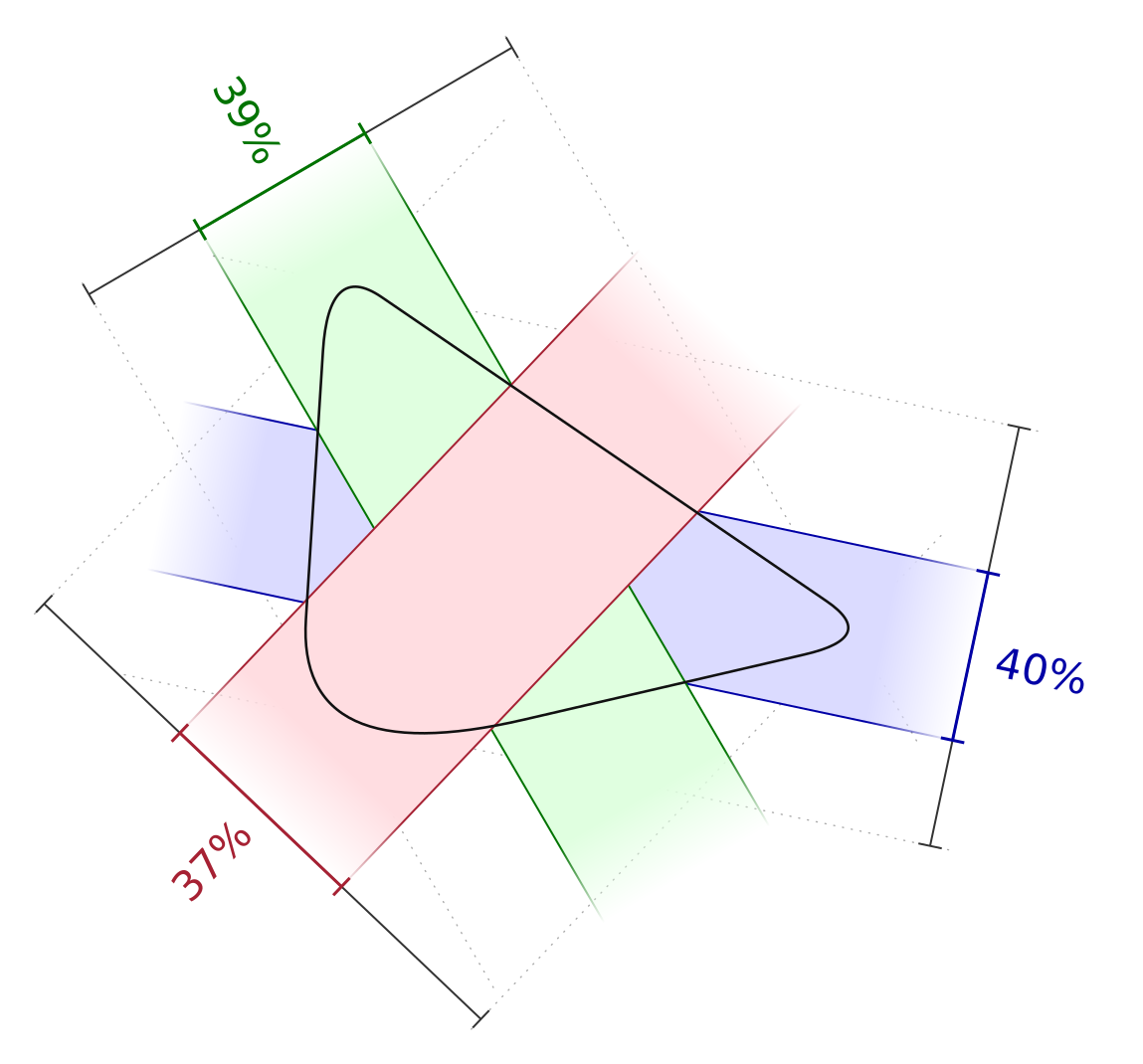
To understand what this means, see my interactive presentation. Or if you just want to see something beautiful, check out the last slide.
This became known as the Affine Plank Conjecture and has remained unsolved for 75 years. We finally prove it for three planks in a plane.
Three planks
These papers give proofs for triangles and for general convex bodies in the plane. Each has an accompanying Lean formalization.
- An elementary proof
of the affine plank conjecture for three planks on a triangle
A short proof for triangles using elementary geometry. - The affine plank
theorem for three planks in the plane
A proof for any convex body in the plane.
Acknowledgements
I'd like to thank Fedor Nazarov for introducing me to the problem, Kevin Barreto for inspiring me to tackle ambitious mathematical problems with LLMs and proof assistants, and the ARIA Safeguarded AI programme for providing funding for LLM usage.
I'd also like to thank Orion Reed for Bireactive, which is used in the interactive presentation.